
 |
| John Keats source: Wikipedia |
Some famous people that suffered mental disorders are;
- John Keats, Poet. He suffered Disorders of fear and anxiety.
- Victoria, Queen of England also suffered disorders of fear and anxiety.
- Marilyn Monroe, actress. She disorders of depression.
- Abraham Lincoln, U.S President, suffered disorders of depression alternating with mania.
-Jean-Jacques Rousseu, Philosopher, suffered disorders involving a loss of reality.
- Vincent Van Gogh, artist, and George III, King of England, also suffered similar disorders.
- Betty Ford, U.S First Lady, suffered disorders of dependence on alchohol and other substances.
- Elizabeth I, Queen of England suffered eating disorders.
PAST VIEWS ON ABNORMAL BEHAVIOUR
- Historical research shows that pre-historic society viewed abnormal behaviour as the work of evil spirits. Evidence shows that trephination was a primitive form of brain surgery for treating abnormal behaviour. People also tried to drive out the "evil spirit" through exorcism.
- Hippocrates believed that abnormal behaviour was due to an imbalance of body fluids: black bile, yellow bile, blood and phlegm. What is today suspected to result in the four temperamants of : Sanguine, Phlegmatic, Choleric and Melancholy.
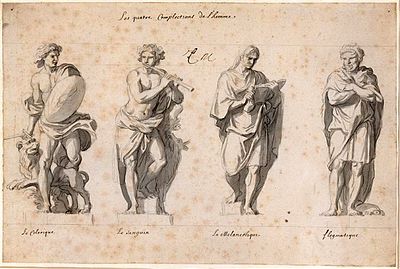
- In the middle ages, Europeans strongly believed abnormal behaviour/mental disorders were the work of the devil. Demonology and its harsh treatment reduced by the end of the middle ages in the western word.
- There was visible improvement during the renaissance, as individuals suffering from disorders were taken care of and treated as humans. Religious shrines supported the humane treatment of these people. This method was short-lived though, as by the middle of the 16th century, persons with mental disorders were ware-housed in asylums.
- Improvement was once again visible in the 19th century, first at La Bicetre asylum in Paris. The people suffering disorders were treated with kindness. William Tuke started something similar in England, and it was known as a moral treatment methodology. Benjamin Rush adopted this method in the United States. Dorothy Dix started a movement for legal rights and protection of these abnormal people, and to establlish state hospitals for their care.
This system wasn't very successful, as moral treatment was costly, and it became impossible to provide individual care to the patients. Mental hospitals once again became ware-houses, with the inmates recieving minimal care.
- There was once again a change in the late 19th century. The somatogenic perspective viewed abnormal behaviour with physical causes. The work of German medical researcher, Emil Kraeplin, and Anatomical and biological discoveries factored this change.
 |
| hypnotic seance (1887) by Richard Bergh |
- Today, there are many professionals who offer help to people with psychological disorders. Also, numerous theories concerning mental disorders have emerged.
TREATMENT
Therapy is a procedure for helping people to overcome their psychological problems. Therapy though, varies in different ways. More than 400 distinct forms of therapy are being practiced today.
Global therapists believe that the clients' personnality is the root of the problem. While Problem-based therapies focus primarily on symptoms and specific complaints, not delving into personnality issues.
The leading therapy format is Individual therapy. There are also: group, family and couple therapy.
The Question here is whether or not these various treatments actually help people cope with and overcome their psychological problems.
Comments
Post a Comment